The Silent Danger Threatening Your Position
Jobs are scary to talk about, but we need to address this topic differently. The first sign that your job is on thin ice is often a full calendar and no clue what's actually happening.
This isn't meant to frighten you, but to be honest about how we actually see our jobs and where productive work is happening in 2024. Your calendar might be full, your manager happy, the work getting done, but the most dangerous moment in a job isn't when everything collapses overnight. It's when the work still exists, but less and less of that work actually needs you.
The Travel Agent Pattern: A Cautionary Tale
Consider what happened to travel agents. Expedia didn't erase this profession overnight. Online booking changed the economics of routine work at first, but nothing really changed initially. The data doesn't show an immediate drop in travel agents.
The visible break came later when economic downturns forced the industry to admit what had already changed. This is the pattern that much of knowledge work is sitting inside right now.
AI Doesn't Replace—It Erodes
According to OpenAI and University of Pennsylvania researchers, about 80% of US workers could have at least 10% of their tasks affected by language models. One in five could see half their tasks affected.
Microsoft's research on 200,000 Bing Copilot conversations reveals that the most common work people bring to AI isn't some weird edge case: it's simply gathering information and writing. AI excels at writing, teaching, providing information, and advising.
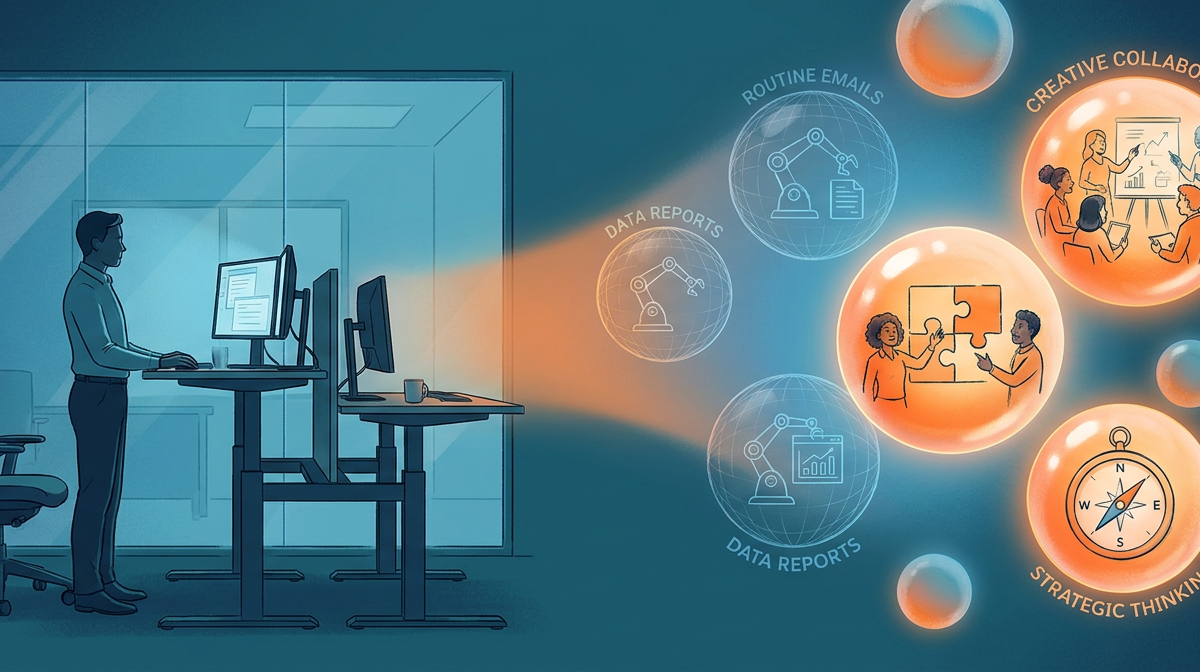
AI isn't just coming for whole jobs. It's actually targeting pieces inside jobs—bits of tasks that live within a role.
So the useful question isn't "Will AI replace me?" but rather: "How much of my last two weeks actually needed me?"
The Four-Bucket Audit: TCLD
Here's a quick audit you can run on your work, separating your week into four categories:
T - Theater
Let's be honest. Every large organization has its polite fiction layer:
- Status meetings where nobody's actually unblocked
- Decks that exist because someone senior needs something to flip through
- Alignment calls that produce no alignment
- Recurring updates sent because someone asked for them 18 months ago
AI absorbs the theater layer first because theater was already operating below the threshold of real human attention.
C - Commodity
Tasks that can be standardized, automated, or delegated:
- Writing standard emails
- Compiling routine reports
- Basic information gathering
- Updating existing documents
L - On the Line
Work that has direct impact but could be threatened:
- Analysis requiring specific context
- Cross-team coordination
- Decision-making with limited data
D - Durable
Work that genuinely requires your human expertise:
- Complex problem-solving
- Difficult relationships and negotiations
- Strategic innovation and creativity
- Crisis management and emergency situations
How to Conduct Your Audit
- Open your calendar from the last 10 business days
- Review your sent emails, Slack DMs, documents, tickets, and work outputs
- Categorize each activity into one of the four buckets (T, C, L, D)
- Calculate the percentage of time spent in each category
The Slow-Then-Sudden Pattern
Jobs tend to change slowly, then suddenly. Five years ago, if too much of your role was routine, the risk was just that it was slow. Maybe someone cheaper could do it, maybe someone faster. But that risk moved at a pace of months and years.
What changed is the competition. Routine knowledge work is no longer being competed away only by other people—it's being compressed by tools that don't have the same throughput limits.
This creates a weird lag where your work can still look fine from the outside. Documents get written, updates go out, meetings happen. But the important question isn't whether the output happened—it's whether that output really required you and your expertise.
Most performance systems are terrible at this question because they're designed to measure visible output, not whether that output genuinely needed human intelligence.
What to Do After Your Audit
The goal isn't to scare yourself but to move your time and identity toward the work that matters.
If You're Mostly in "Theater" and "Commodity":
- High urgency: Start repositioning immediately
- Identify durable skills to develop
- Seek more strategic projects
- Propose initiatives requiring human expertise
If You're in "On the Line":
- Moderate concern: Evolve toward more durable work
- Develop expertise in complex domains
- Strengthen relationships and internal network
If You're Mostly in "Durable":
- Good position: Continue deepening expertise
- Document and communicate your unique value
- Help your team orient toward durable work
The Survival Strategy
The travel agents who survived didn't defend routine booking as a professional identity. They moved toward work that still needed trust, taste, context, and judgment—planning complex trips, corporate travel, luxury travel, handling emergencies.
Similarly, knowledge workers who thrive will be those who focus on what genuinely requires human intelligence, empathy, and judgment.
Your Job Is Not One Thing
Your job isn't one monolithic entity—it's 50, 60, or 300 small things packed into one title. Some of those things are real and durable. Some are real but increasingly not specific to you. Some are valuable today but moving in the wrong direction. And some were always a bit of professional theater.
The key is identifying which is which before your organization decides for you.
The Bottom Line
You're not alone in noticing these shifts. Many people can feel the ground moving but lack a practical way to change their week before the organization changes it for them.
The transformation is inevitable, but it's manageable. Start now to identify and cultivate the parts of your work that will remain valuable even as AI excels at routine tasks. The danger isn't that AI takes your whole job in one clean move—it's that AI removes the parts that were quietly propping up the rest of your professional story.
By conducting this honest audit and acting on what you discover, you can position yourself not just to survive but to thrive in the AI-augmented workplace of tomorrow.