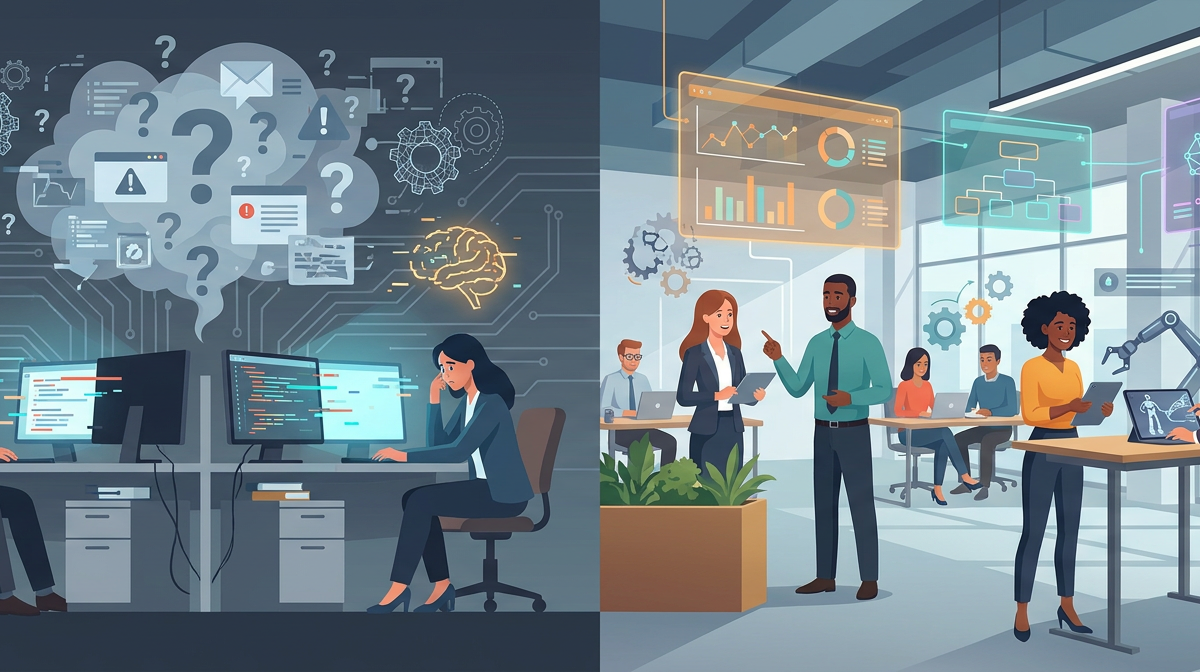
Every company dreams of AI transformation, but very few actually achieve it. Yet they don't lack budget, ambition, or available tools in the market. So where's the problem?
Whether in large corporations, SMEs, consulting firms, or agencies, across different sectors, sizes, and corporate cultures, the same mistakes occur systematically. Between wanting and doing, there's a gap that few organizations truly bridge.
1. Deploying Tools Before Training Employees
This is mistake number one, by far the most frequent.
The classic scenario unfolds like this: companies buy licenses, deploy technological solutions, sign partnerships with vendors. And training? It comes later, if it comes at all.
The result is predictable: tools are available, but nobody really knows what to do with them. Six months later, management wonders why adoption isn't taking off and why ROI isn't materializing.
Training isn't the cherry on top. It's the starting point. Without it, all technological investments are just wasted budget. Employees need to understand not only how to use the tools, but especially why and in what contexts.
2. Not Deploying LLMs at Scale or Choosing the Wrong Tool
Two problematic scenarios regularly emerge:
Massive Shadow AI
Each employee uses their personal version of ChatGPT or Claude on their smartphone. Client data transits through unsecured servers, and nobody really understands the risks. This "shadow AI" phenomenon is massive in large organizations.
The "Sovereign" but Unused Solution
To avoid security risks, IT departments deploy homegrown chatbots or "sovereign" third-party solutions that check all the security boxes. Problem: no employee uses them because they're half as effective as consumer solutions. Result: shadow AI quickly reclaims its territory.
The right approach is actually simple: deploy proven tools (Claude, ChatGPT, Copilot) in their secure enterprise versions, across the entire organization. Not in six months, but now.
3. Relying Only on E-Learning
A 45-minute training module, a quiz at the end, a checked box in the LMS (Learning Management System). "Our teams have been trained in AI."
No. They watched a video, at best.
E-learning raises awareness, but it doesn't transform practices. What truly transforms practices is hands-on training with real use cases, using actual tools, in genuine business contexts:
- A lawyer testing Claude on their own contracts
- A salesperson automating their actual client follow-up sequence
- A marketer optimizing campaigns with AI tools
This is when the breakthrough happens. Not before.
4. Ignoring Change Management
Deploying AI aggressively, without considering employees' legitimate concerns, is the best way to create lasting resistance.
Many employees are afraid:
- Afraid of losing their jobs
- Afraid of doing things wrong
- Afraid of being judged if they don't adopt new tools quickly enough
These fears are perfectly legitimate. Ignoring them only amplifies them.
Change management isn't just a team-building workshop at the end of a seminar. It's a structured approach that:
- Acknowledges and addresses concerns
- Personally supports the most reluctant individuals
- Adapts job descriptions to clarify what AI now does and what the employee does in addition
Without this clarification, teams navigate blindly and naturally resist change.
5. Not Identifying Use Cases with Field Teams
Too often, AI use cases are defined at the top of the hierarchy, by management or external consulting firms, then "cascaded" down to operational teams.
Major problem: teams don't recognize themselves in these use cases, don't believe in them, and therefore don't use them.
The best use cases don't come from the top, but from the field. Employees are the ones who know:
- Which tasks waste their time unnecessarily
- Which processes are absurd or inefficient
- Which deliverables could be automated or optimized
Involving teams from the start isn't a matter of form or internal diplomacy. It's what makes the difference between a deployment that takes root and one that stays on PowerPoint slides.
6. Not Having an Internal AI Charter
Employees use AI, but nobody has clearly explained what they can or cannot input into these systems. Client data, confidential information, internal documents: everything goes through models whose terms of use and risks nobody really understands.
An internal AI charter isn't just another administrative document. It's what allows your teams to use these tools with confidence, knowing exactly where the boundaries and best practices lie.
Without this charter, you face two bad options:
- Employees who don't use AI for fear of doing something wrong
- Employees who use it carelessly without measuring the risks
The Key to Success: Treating AI as a Human Project
These 6 mistakes have one fundamental thing in common: they treat AI like an IT project when it's primarily a human project.
Tools are now accessible to everyone, models are available to all companies. What makes the difference between an organization that truly transforms its practices and a company that just talks about it is how it brings its teams along in this transformation.
Technology is just the enabler. The real challenge is human adoption. And this can't be improvised: it must be planned, supported, and measured with as much rigor as any other strategic company project.
Moving Forward: A Human-Centric Approach
Successful AI transformation requires putting people at the center of the strategy. This means:
- Starting with training before any tool deployment
- Choosing proven, enterprise-grade solutions that employees will actually want to use
- Combining e-learning with hands-on, practical training in real business contexts
- Implementing structured change management that addresses fears and concerns
- Co-creating use cases with field teams who understand the actual pain points
- Establishing clear guidelines that enable confident, secure AI usage
The companies that succeed in AI transformation understand that technology adoption is ultimately about people adoption. They invest as much in the human side of the equation as they do in the technology itself. And that makes all the difference between AI projects that deliver real value and those that become expensive learning experiences.