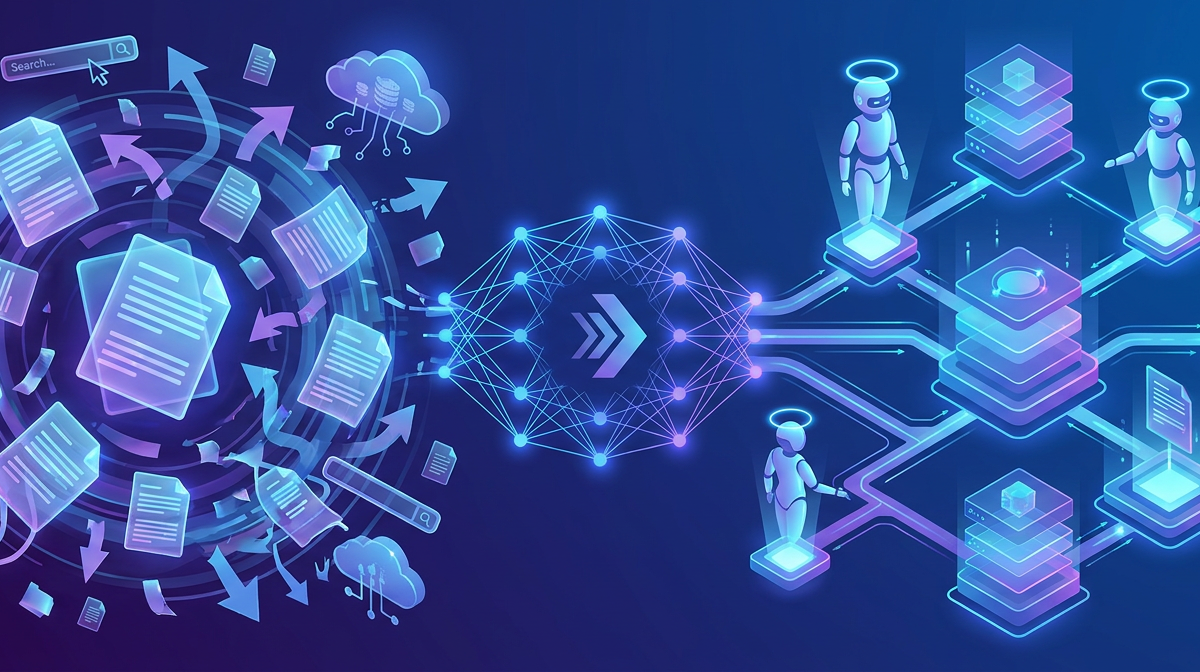
The artificial intelligence industry is witnessing a pivotal moment. As agentic AI systems become increasingly sophisticated, the limitations of traditional vector databases and RAG (Retrieval-Augmented Generation) architecture are becoming undeniably clear. Pinecone, the vector database pioneer, has just unveiled its answer to these challenges with Nexus, a revolutionary approach that fundamentally reimagines how AI agents access enterprise knowledge.
The Decline of Traditional Vector Databases
According to VentureBeat's Q1 2026 Pulse survey, every standalone vector database is losing adoption share, while hybrid retrieval intent has tripled to 33.3%, becoming the fastest-growing strategic position in the dataset.
This shift isn't surprising. Current RAG systems were designed for human users, not AI agents. As Ash Ashutosh, Pinecone's CEO, explains: "RAG was built for human users. Nexus was built for agentic users, because their language is very different. The responses they expect are very different."
RAG's Structural Limitations for Agentic AI
The fundamental problem with RAG lies in its very architecture. This approach operates on a "one query, one response" principle with a human in the loop to interpret results. But AI agents work differently:
- They receive tasks, not simple questions
- They must assemble context from multiple sources
- They require deterministic conflict resolution
- They need to track what has already been retrieved
The result? According to Pinecone's estimates, 85% of agent compute effort goes to the re-discovery cycle rather than task completion. This inefficiency generates:
- Unpredictable latency
- Runaway token costs
- Non-deterministic results
Nexus: A Revolutionary Architecture
The Contextual Compilation Principle
Nexus introduces a fundamental paradigm shift: moving reasoning work from inference time to compilation time. Instead of reinterpreting data every session, Nexus reasons just once during a compilation stage that runs before any agent query.
Nexus's Three Key Components
1. The Context Compiler
This component takes raw source data and a task specification to build specialized knowledge artifacts. These structured, task-optimized representations are consumed directly by agents without interpretation overhead.
2. The Composable Retriever
Compiled artifacts are served at query time with:
- Typed fields
- Per-field citations with confidence levels
- Deterministic conflict resolution
3. KnowQL: A Declarative Query Language
Pinecone presents KnowQL as the first declarative query language designed for agents rather than humans. Six primitives allow agents to specify:
- Intent
- Filters
- Provenance
- Output shape
- Confidence
- Latency budget
Impressive Results
In Pinecone's internal benchmarks, one financial analysis task that previously consumed 2.8 million tokens was completed by Nexus with just 4,000 tokens. This represents a 98% reduction in token consumption.
Expert Analysis
Stephanie Walter, practice leader for AI stack at HyperFRAME Research, emphasizes Nexus's directional importance: "The real innovation isn't the idea itself, but the productization of knowledge compilation as a first-class infrastructure layer."
Arun Chandrasekaran, Gartner distinguished VP analyst, highlights the meaningful architectural distinction: "Unlike traditional RAG, which relies on pure semantic search at runtime, architectural compilation embeds structural logic into the metadata layer."
The Competitive Landscape
Pinecone isn't alone in recognizing these limitations. Microsoft has extended its FabricIQ technology, Google recently announced its Agentic Data Cloud, and standalone contextual memory technologies like Hindsight offer alternative approaches.
However, analysts advise enterprises to focus not on features but on control: cost control, governance control, and security control.
Enterprise Implications
An Architectural Problem, Not a Tuning Issue
Teams running complex agentic workloads on conventional RAG pipelines are burning tokens at inference time on work that could be done in advance. This is a design problem that tuning the retrieval layer cannot fix.
Governance as the Differentiator
As Walter emphasizes: "The real enterprise value proposition isn't just faster retrieval, but governed knowledge pipelines. Those are the capabilities that turn agentic AI from an experiment into something finance and risk teams will actually approve."
Investment Evolution
VentureBeat's Q1 Pulse data shows that retrieval optimization investment rose to 28.9% in March, overtaking evaluation spending for the first time. Enterprises have finished measuring their retrieval problems and are now spending to fix them.
The Technical Deep Dive
Moving Beyond Simple Vector Search
Traditional vector databases excel at finding semantically similar content but struggle with the complex reasoning tasks that agents require. Nexus addresses this by:
- Pre-computing relationships between data sources
- Establishing authoritative sources for specific question types
- Creating task-specific knowledge representations
- Maintaining persistent context across agent sessions
The Role of Deterministic Grounding
As Chandrasekaran notes, the true differentiator is deterministic grounding—ensuring agents understand structural relationships within enterprise data rather than returning surface-level matches. This capability is crucial for enterprise compliance and auditability requirements.
What This Means for Data Engineering Teams
The transition from RAG to compilation-based architectures represents more than a technological upgrade—it's a fundamental shift in how organizations think about knowledge management for AI systems.
Key Evaluation Criteria
- Pre-compilation Capability: Can your current stack structurally handle pre-compiling knowledge for specific agent tasks?
- Governance Integration: Do you have governed knowledge pipelines that satisfy enterprise compliance requirements?
- Cost Predictability: Can you control and predict token consumption at scale?
- Interoperability: Does your solution support standards like Model Context Protocol (MCP) for connecting to legacy data sources?
The Future of Enterprise AI
The shift from RAG to compilation-based knowledge layers represents a maturation of the enterprise AI stack. As Walter concludes: "The future of agentic AI won't be decided by who has the longest context window. It will be decided by who can operationalize trusted knowledge at scale without blowing up cost or governance."
Conclusion: A New Era Begins
With Nexus, Pinecone isn't just improving existing technology—they're proposing a new architecture for the agentic AI era. By moving from inference-time reasoning to compilation-time knowledge preparation, they're addressing the fundamental scalability and cost challenges that have limited enterprise adoption of agentic AI.
While Nexus is currently in early access, its approach signals a broader industry shift. The RAG era, characterized by real-time document retrieval and interpretation, is giving way to a new paradigm of pre-compiled, task-specific knowledge layers designed from the ground up for autonomous AI agents.
The question isn't whether this transformation will happen—it's whether organizations will adapt their knowledge infrastructure quickly enough to capitalize on the opportunities that truly scalable agentic AI will create.