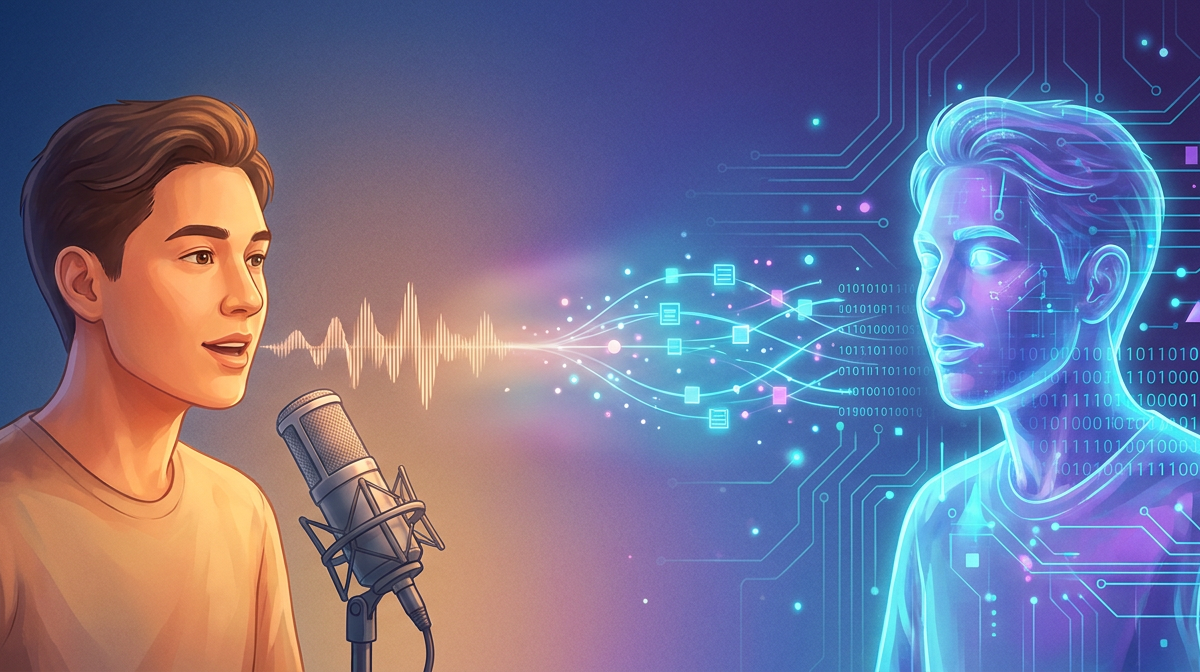
Voice cloning through artificial intelligence is no longer futuristic technology. It's a present reality, accessible and convincing enough to fool most listeners in normal listening conditions. But contrary to what many believe, the real danger doesn't come from perfectly undetectable AI.
The Unsettling Demonstration
Imagine listening to a video from a content creator you regularly follow. The voice sounds familiar, the tone is recognizable, the rhythm matches what you know. Except this time, it's not really them speaking. It's a voice clone generated by AI from previous recordings.
This experience is no longer hypothetical. With enough quality source audio, current tools can create remarkably convincing voice clones. And here's the crucial point: the threat isn't perfect AI, but 'good enough' AI in a low-attention environment.
The Paradox of Fragmented Attention
Most media content is consumed casually. People listen in the background, watch while doing something else, view a few seconds before moving on to the next piece of content. YouTube isn't a forensic lab. Neither is TikTok. LinkedIn definitely isn't.
So the threshold isn't "can this fool an expert watching carefully?" The real threshold is: can this create enough ambiguity that normal people stop knowing what relationship they have to the person on screen?
If you carefully examine an AI-generated video clip, you'll notice the anomalies: a weird mouth movement, strange timing, eyes that don't quite behave naturally. But how many people actually take the time to analyze the content they consume this way?
The Uncanny Valley Becomes Relational
The "uncanny valley" is no longer just visual. It has become structural, institutional, relational. The questions are no longer simply:
- Does this face look real?
- Do the eyes move correctly?
- Does the mouth move naturally?
The real questions now are:
- Do I believe there's a person behind this?
- Do I believe there was a process?
- Do I believe someone made a judgment?
- Do I believe someone is accountable if this is wrong, manipulative, or fraudulent?
The Five Hidden Questions Behind "Was This Made With AI?"
When someone asks "Was this made with AI?", they're actually asking at least five different questions simultaneously:
- Was the voice synthetic?
- Was the face synthetic?
- Was the script synthetic?
- Was the idea synthetic?
- Did a human actually approve and stand behind the final output?
These questions are fundamentally different. A creator using AI to clean up audio is not the same as a creator secretly replacing themselves with a clone. A company using AI to draft a first version of a training video is not the same as cloning an employee's voice without consent.
The Creator Trust Stack
Rather than asking the binary question "AI or no AI?", we need a more nuanced framework. Here's the creator trust stack in five layers:
Layer 1: Disclosure
What was synthetic? Was the voice cloned? Was the face generated? Was the script drafted with AI? Was the edit assembled with AI? Say it clearly.
Layer 2: Provenance
Where did the source material come from? Was the voice clone trained on recordings the person consented to? Was the avatar made from authorized footage? Was the data scraped, licensed, owned?
Layer 3: Control
Who had the ability to approve, reject, or change the output? Did the person being cloned have control over the use of their likeness?
Layer 4: Judgment
Who actually made the argument? Who decided what this video meant? Who decided what claims were worth making?
Layer 5: Accountability
If the video is wrong, manipulative, or harmful, who owns that? This is the part many want to skip, but it's probably the most important.
When Humanity Becomes Suspicious
A strange phenomenon is beginning to emerge: human weirdness starts looking like machine weirdness. Someone mispronounces a word? "That's AI." Someone wears the same shirt in four videos because they batch recorded? "That's AI." An awkward pause, a weird edit, a tired delivery, a strange facial expression? The comment section becomes an impromptu Turing test.
But humans are inconsistent. Humans get tired. They repeat themselves. They sometimes say something a little wrong and keep going. Humans have bad hair days. Humans blink weirdly. Humans do not always perform humanity in a clean, legible, perfectly edited way.
What Creators Must Do
Faced with this new reality, here are five essential principles:
1. Disclose synthetic media clearly
Not in a paragraph buried in the description. Not in a vague "AI-assisted" footnote. Be specific.
2. Never clone voices or faces without consent
This should be obvious, but apparently we're living through a period when obvious things need to be stated clearly.
3. Preserve human judgment
Use AI for leverage, not for deception. Draft faster, edit faster, prototype faster, but don't outsource responsibility for what you're saying.
4. Make the audience more literate
If you use a clone, show it, label it, and explain what it can and can't do. Help people understand the difference between synthetic media and synthetic accountability.
5. For companies: create the policy before the scandal
Who can approve a voice clone? Who can use an employee's likeness? What happens when someone leaves? What gets labeled? What gets logged? What's never allowed?
The Future Belongs to Those Who Preserve Trust
The future doesn't belong to creators who never use AI – that's a fantasy. It also doesn't belong to creators who quietly automate themselves and hope nobody notices.
The future belongs to people who can use AI without breaking trust, because trust is becoming the scarce asset. Not content – we'll have infinite content. Not polish – AI can polish. Not even voice – it can be cloned.
The scarce thing is judgment, taste, and accountability. The sense that a real person made choices and is willing to stand behind them. The buck has to stop somewhere.
Yes, someone can clone my voice. But they cannot clone the responsibility for what I choose to say with it. And ultimately, that's where the line has to be.
Being human is no longer enough. You have to be legibly human in this world. And if you're going to be synthetic, you have to be legibly synthetic too.